• Skip to main content

Tifanie Charboneau

Hide Search

Admin

Tracing a Packet through the OSI network layers, part one

Admin · December 23, 2025 ·

The OSI model has seven layers. The layers are conceptual, for the most part. The bottom most layer is usually considered the physical layer. This is where all the information is in ones or zeros, 1 or 0, as the written form of ON or OFF. An ON or OFF switch, a hole in a punchcard, or a solid spot on the punchcard, a positive electric charge or an negative charge. A tone, a silence.

A one or zero, 1 or 0, is one tiny bit of information. More information is sculpted from deliberate groups of ones and zeroes. The smallest group is called a bit- one or zero. The typical smallest grouping is called a byte- eight possible yes or no spots- 11110000- or 10101010- or any other combination.

The computer works with the ones and zeros, the zots and zaps of electricity rushing over wires from here to there, like commuters crowding on to subway platforms and then into subway cars. The steps in the model between the keyboard and the electrons form the layers of the OSI model.

Admin · December 21, 2025 ·

Loader Loading…
EAD Logo Taking too long?

Reload Reload document
| Open Open in new tab

https://tifaniecharboneau.com/54-2/

Daily Sales Brief

Admin · October 29, 2025 ·

Loader Loading…
EAD Logo Taking too long?

Reload Reload document
| Open Open in new tab

Business Case #2: Taking a financial services company paperless

Admin · October 28, 2025 ·

A traditional financial services firm was scheduled to close in three months time. The office had ten years worth of financial documents, a depressed sales staff and a failed office culture.

The top sales person at the corporation was a salesman who worked from home with a laptop with a VPN connection to the corporate private cloud.

The contract was to watch the phone and receive packages. The contractor confirmed with the regional manager a desperate plan to copy the top salesperson. The office was first cleared of out of date sales documents- a clear SEC violation. The remaining paperwork was scanned into the corporate headquarters private cloud. Each salesperson was given a private file drive. The files were governed by Federal Trade Commission privacy policies, to comply with regulations from the Gramm-Leach-Bliley Act.

The sales team had been confined to selling products at the main office. The conference room was forbidding. The office was hidden off a high congested traffic road. People did not want to show up for a high pressure sales pitch in an uncomfortable, forbidding conference room after fighting through traffice, and then getting lost on the way to the office. This was before widespread driving navigation applications on cellphones. Just getting an appointment with a prospective client was a hard sales pitch.

After being untethered from the office and equipped with laptops that could securely load both all the sales documents and pamphlets and all of the customers’ information and contracts, the sales team was able to close enough business to keep the business not just afloat, but flourishing. The company did not close. Within six months they had moved to a new, more modern address. The company tripled its sales staff.

Each salesperson set appointments and then drove out to the customers’ preferred venue. People were hearing about the financial plans in the comfort of their own home. They were more willing to sign up for the offers. The current customers were more interested in increasing their investments. The sales staff made more money.

The higher end salesmen then decided to pursue institutional customers. They would pack their laptop and fly to a distant city and make a sale to a union fund, or business pension fund. They would fly out as soon as there was interest. Their velocity and commitment increased sales.

The company grew exponentially.

Wireshark Reading

Admin · October 25, 2025 ·


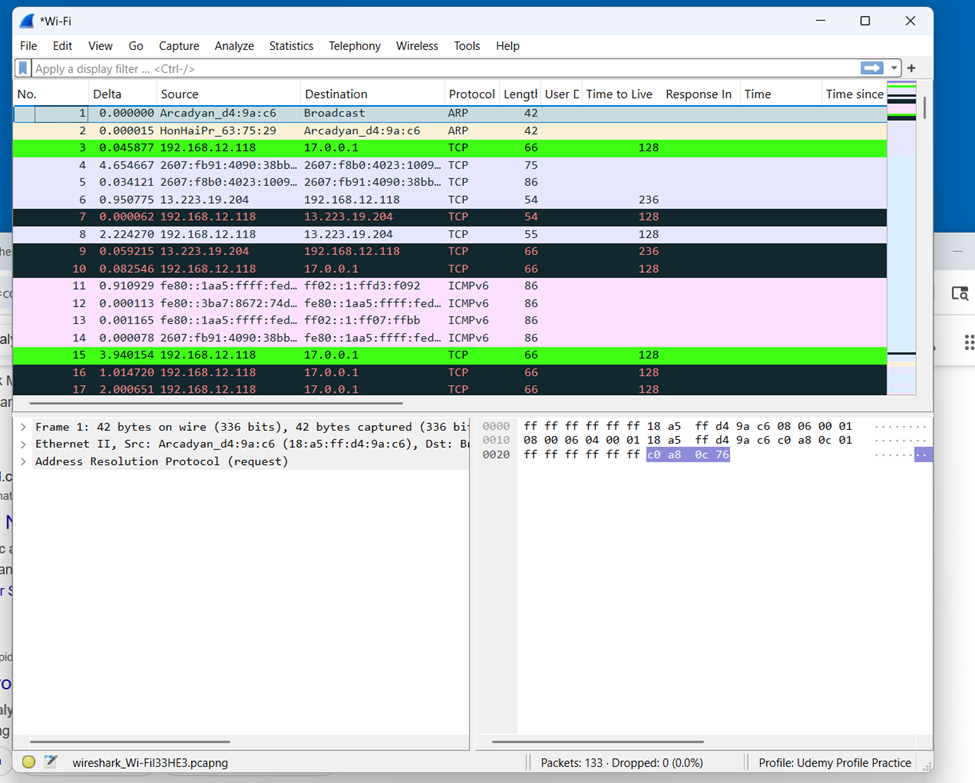
This is a screenshot of a packet capture. It shows the first part of the minute when Wireshark was called up on the computer and began capturing. The screenshot shows 133 packets captured. None have been lost.

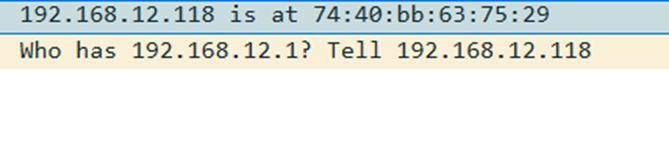
The first packet is a broadcast packet. The router has sent out an ARP request to see what computers are responding on this home network. The sender IP address is 192.168.12.1, which is the router. The router sent out a broadcast. The IP address target was 192.168.12.118. This is this computer’s assigned IP address on this network, which is a private home network.

The second packet is a routing ARP packet. The third packet is a transmission control protocol syn packet from a private address- 192.168.12.118 to 17.0.0.1. The private address is this computer, as it is a home computer on a mass market subscription router.

The three black lines show a TCP ACK unseen: a transmission control protocol acknowledgement was not seen, packet 7. Packet 9 is black to show that a packet was not captured. Packet 10 is a retransmission of a syn packet.

Packets 12, 13, and 14 are neighbor advertisements. This is a home network with multiple computers on the system.


This is the filter for the arp request. The computers have such poignant questions for each other, as they speak into the void.


  • « Go to Previous Page
  • Page 1
  • Page 2
  • Page 3
  • Go to Next Page »

Tifanie Charboneau

Copyright © 2026 · Monochrome Pro on Genesis Framework · WordPress · Log in